
The riches are in the niches
23 January 2024

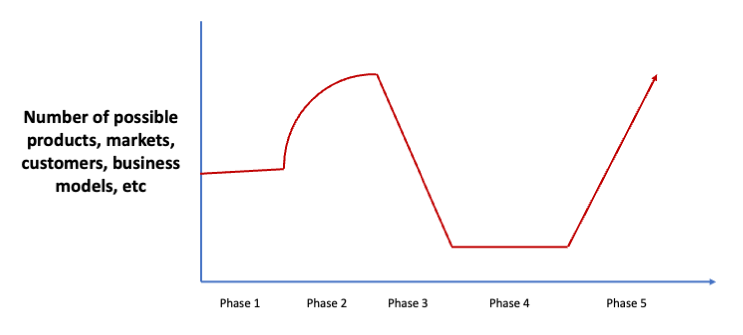
Yes, this is a total oversimplification, but there are 3 broad buckets of companies in my experience:
- Those that are Rocket Ship successes early on (within 1-3 years)
- Those that fail reasonably quickly (within 1-3 years)
- Those that somehow limp-along for many years, perpetually saying "we've made X change/addition, next QTR it's going to really turn". Narrator: "it doesn't".
Early rocket ship successes have attributes that are so special they are very hard to analyse and straight out copy. If it were easy, everyone would do it. There are just a whole range of ingredients coming together and within a few years it just takes off. Yet in the mix, you'll find a great niche where they get product market fit quickly.
Fast failures happen when you can't generate cash greater than expenses organically, and/or can't raise capital past the 3 F's (Friends, Family, Fanatics), generally because you can't demonstrate the opportunity to more professional/sophisticated investors.
But the "limp-along" crew are the most painful, for obvious reasons. They are hard-working founders, that give it their all. Clever people that are not stupid. Whilst investors put their hard-earned capital into the company, that is all we lose. For founders, they lose a big chunk of their life, and it can be hard to watch as good people struggle.
What I have learnt for this "limp-along" group is that if there is to be an exit from this situation, the exit is when they start doing less for less groups of people.
Less is more
Here is a pattern I see for a good percentage of these "limp-alongs":
Phase 1: Many of the businesses that end up in the limp-along group were born trying to do multiple things for multiple people. Or at least they are seeking to do one thing, but for many different markets and/or ideal client types. They could start focused, but that is not the entrepreneurial impulse.
Phase 2: Things do not go as easy as they planned, and the impulse is to resolve revenue/growth problems by seeking new markets and client profiles. They seek to add new customer groups or solve different problems in new markets. To a certain extent this is a normal part of the very early journey — try and test a range of markets, verticals and ideal client profiles whilst trying to find product-market-fit.
Phase 3: They start to focus and learn the value of "no", because either they start to realise that focus is going to achieve a better outcome (less than 10% I would say), or they start to run out of runway where bankruptcy becomes a real risk. Investors start to make it clear that without improved results, there won't be any more capital — it sharpens the mind.
Phase 4: If they do not run out of investor support and need to close the doors (the majority), and they focus on a "good" niche, magically things start to change. They find "the riches are in the niches after all!". It may have taken years, but by going narrower and putting all the energy into a product-to-market combination that they can win, they start to build momentum and generate cash.
Phase 5: With "power" and cashflow from owning their niche, they can either organically expand, or get investors excited to finance their expansion. New products, new markets, new geographies. This strength gives them the ability to go back to markets and customers they previously said no to, now able to say yes given the stronger base.
Why is this the case?
Every additional product, ideal customer, market etc divides up resource, focus and time. Complexity can multiply, almost exponentially in some cases. The entrepreneurial impulse has difficulty seeing this. Energy and time are infinite don't you know?
Your homepage and website becomes more complicated as we need to have words and pictures that try and resonate with all the different markets, verticals, and ideal client profiles. The messaging becomes broad and generic.
The operational processes become convoluted accommodating different markets and customers. Development resources get pulled left and right, and key features take too long to come to market.
It hurts the entrepreneurial brain to say "less is more". "More is more!". But once you find yourself in the limp-along desert, it rarely is.
The power of 5 "ones"
Time and time again we see the fastest way to success, assuming the market is big enough to create a real business is:
- One market
- With one ideal customer
- That has one big problem they will pay to have solved
- Through one product/service you provide better than anyone else
- You find through one channel that you own
Like I said at the beginning, this blog will be oversimplified, and yes, the above lacks industry/product nuance. Some customers are identical, so it can make sense to combine and have multiple. As an example, for some products, SMBs across a very wide range of industries is appropriate because what you are doing for those customers is exactly the same. Employment Hero, Xero, and HubSpot are prime examples of this.
Where a company has both B2B and B2C customers in their early phase, this is almost a guaranteed path to failure I have come to realise. You can do both when one becomes profitable allowing them to expand from a position of strength, but until then, chasing both is a ticket to mediocrity and insolvency.
When you have focus you get to know customers reaaaallly well. You get to create messaging that is amazingly engaging to them. You develop operational processes that create real power that others can't replicate. You create scale economies with these customers, so you serve them better than anyone else.
Yeah, yeah, I know, you are different. But success leaves clues.
Entrepreneurs in the limp-along cohort generally push against this. Every reason under the sun is provided:
- It's such a big opportunity doing this additional market/segment/user.
- There's leverage between these two. They will help each other.
- If we ignore this market/segment/user, we will lose X% of revenue (usually a small %).
And maybe you are right.
I'm just an investor, standing in front of founders, asking them to learn from others as "success leaves clues".
Here's a personal example: I started an insurance claims management business that focused only on domestic building claims in the sub $10k range in QLD. I also started a SaaS business that sold workflow management SaaS to the builders focused on these small claims.
Do you know how big the insurance claim market is? 1000 times bigger than this little niche! And guess what? I did go after it in the end. We went from managing zero to hundreds of millions. From a small private company to listed on the ASX. But only when we had millions of dollars of profits from our tight niche that we reinvested into going into new verticals. Had I tried to go broad and wide at day one, no chance.
Facebook had one type of social network for one type of university. Google had a very simple but effective search function. Amazon started with only books. Microsoft had one operating system.
The TAM isn't big enough
A common complaint is that each niche is too small. Ok then, we have a different/bigger problem to deal with. Building a great business needs a certain size TAM but understand the issues with too broad too soon. Entrepreneurs tend to sometimes forget that TAM can expand with success — if you own a smaller TAM, you can then go bigger in time.
I'm focused, the TAM is big enough, but I'm still struggling
This often means the problem that you are solving just is not as big a problem to the customer as it is to you. It looks like the TAM is big, but your customers just don't care that much to want to solve it, or are not willing to pay enough to solve it. Adding more markets and customers usually just makes it worse. Customer apathy is a hard one to change.
The cost to acquire customers (CAC) can be a killer for some verticals and hard to create a scalable and sustainable business. Sometimes this can be fixed, sometimes it can't and you need to move on.
It's not a problem
Entrepreneurs also come across situations that look like a problem, but it's not really a problem. Or if it is, it is not a big enough one to pay money to resolve. Vu Tran of Go1 talks about being a GP and sending over 20 faxes a shift. People would look at that and say "Faxes! In this day and age? That sounds like a problem!". But for GPs, sending a fax isn't really a problem, and there's a whole series of professionals and entities that would need to change how they operate. Getting one group of people to change is hard enough. When you need to get many groups to change at the same time, that's complex.
New geography before new market
If you do find a niche, the impulse is often to go then into new markets, sectors and verticals within your home market. This may well be a good strategy.
But for some businesses, expanding the same problem-product set into a new geography can be the better way to go if the new geography has similar attributes as the home base. This can also be a solution for your home TAM being too small. Think bigger. Plan to own the small home TAM and very quickly move international from a base of success.
The market messaging and sales process can often scale easier into new geographies than they do into totally new markets/customers.
The risk: it becomes too late
When battling the entrepreneurial urge to cater to everyone and say yes to everything, I'm reminded of the Churchill quote about Americans: "You can always count on Americans to do the right thing – after they have tried everything else". There's an inevitability to what the right things are in the end, but entrepreneurial energy that gets stuck in the limp-along trough tends to want to try it all first.
The bigger issue is smarter competitors come and take the opportunity from you. They then lock you out of the market, or drive pricing down to a level you can't compete.
For consideration
You may be special and can get out of the limp-along desert by staying wide. But if you have been slogging at something for years and years, and nothing you do seems to make "the big difference", AND you have more than one market, customer, and product; there could be something here for you to consider.
More in Learnings
Information on our US & UK Trade Missions
An information session covering who should attend our US and UK trade missions, the schedule, logistics, typical…
Why the UK is great for ANZ B2B tech ventures
Why more ANZ B2B founders should consider the UK before defaulting to North America — customer density, startup-literate…
Messaging that compels customers to engage, with a brand that doesn't turn them off
In early-stage B2B, messaging is about 90% and brand look and feel about 10%. Start with a niche, use the customer's…